
Hunt County Bench Warrants Explained
A bench warrant is a court order tied to a missed appearance or another unmet court duty. In Hunt County, the court that set the case controls its record. A missed city citation can remain with that municipal court; a JP matter stays with the precinct; a misdemeanor or felony process follows its assigned county or district court.
Unpaid fines may lead to a capias pro fine after the required court process. That is not the same as a new arrest warrant. Ask the clerk to use the exact label in the file before choosing a payment, hearing, bond, or appearance route.
Hunt County Municipal Bench Warrants
Greenville’s Municipal Court handles city traffic and ordinance matters and links its own active list. Commerce has an Open Warrants page and a court search portal. Caddo Mills, Quinlan, and Wolfe City publish citation or plea instructions but no dedicated public warrant roster was located. The city court, not the Sheriff, is the first place to ask about its own missed-date case.
A city record may not appear on another city’s portal or on the county Sheriff page. Keep the notice and ask the clerk what the court has recorded.
How Hunt County Bench Warrants Are Issued
A judge may issue process after a required appearance is missed or an order is not met. The court records the action in the case file and directs the appropriate peace officer to execute it. There is no countywide public status feed that automatically combines all issuing courts.
For a fine-only matter, Chapter 45A describes notice, bail, hardship, and capias pro fine steps. A court may need to set a hearing or recall the process before execution. Ask the clerk what order appears now; do not infer it from an old docket date.
Hunt County FTA and Capias Terms
The label helps identify the trigger. FTA means failure to appear. A capias can bring a defendant before court in a pending prosecution. A capias pro fine follows a judgment and relates to the unpaid fine or costs. A recall withdraws the order; a quash sets it aside, while the underlying case may still continue.
- FTA
- Missing a date the court required.
- Capias
- Process used to obtain custody in a pending case.
- Capias pro fine
- Post-judgment process tied to a fine and costs.
- Recall
- The issuing court withdraws the warrant.
Bench Warrants and Arrest Warrants Compared
A bench warrant responds to a court obligation; an arrest warrant follows a probable-cause process for an alleged offense. Hunt County clerks use the issuing court and case posture to route the record. See the arrest warrant process for the separate issuance and service rules.
| Feature | Bench Warrant | Arrest Warrant |
|---|---|---|
| Trigger | Missed date or court noncompliance | Sworn complaint and probable cause |
| Who issues it | Judge in the existing case | Magistrate or judge |
| Case posture | Pending case or unmet court judgment | Criminal charge or investigation |
| How it clears | Court appearance, recall, or other order | Bond, appearance, or court order |
Hunt County's Reset Request Example
Commerce provides a concrete local rule: a reset or continuance request must be made in person or in writing at least 72 hours before court, with a reason and proof. Its FAQ says phone arrangements are not accepted. That rule belongs to Commerce Municipal Court and should not be applied to Greenville, a JP precinct, or another court.
If the missed date belongs to Commerce, contact the clerk before the deadline and retain the written request. For any other Hunt County court, ask that clerk for its own reset and recall process.
Read Commerce’s municipal court reset instructionsThat deadline applies only to Commerce cases; each other court sets its own procedure.
Resolving a Hunt County Bench Warrant
Confirm the court and the process name before paying or appearing. The clerk can say whether the court requires a hearing, accepts a bond, permits a reset, or needs a judge to recall the warrant. A voluntary appearance may not prevent arrest, and Hunt County publishes no universal walk-in window. A lawyer can contact the court and plan the safest available route.
- Use the citation or cause number to identify the issuing court.
- Ask the clerk whether the warrant is a bench order, capias, or capias pro fine.
- Discuss a reset, hearing, recall motion, bond, or planned appearance with counsel.
- Get a receipt, written order, or new setting and ask when the online status changes.
Caution: Do not assume an old warrant expired or that a payment portal recalled it; confirm the order and next date with the issuing court.
Hunt County Warrant Record Requests
When a status call does not resolve a document question, request an existing record from the office that keeps it. The Sheriff’s records form asks for a specific description and offers inspection or copy. The County Clerk handles County Court at Law misdemeanor records; the District Clerk handles district pleadings. Judicial records follow the clerk’s access process, and investigative or juvenile material may be withheld.
The Hunt County Bail Bond Board regulates licensed bond businesses and meets at the 196th District Courtroom. The image shows board contact details, not a warrant or bond amount.
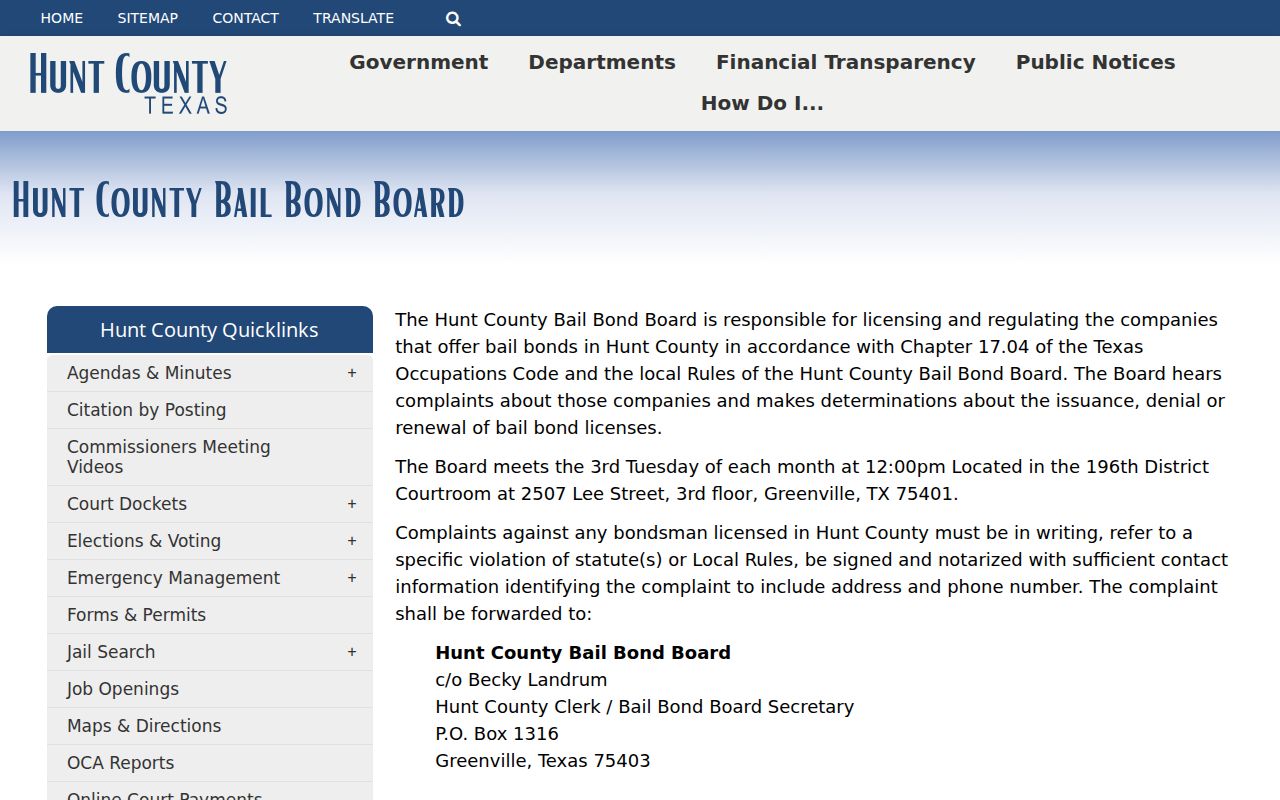
Government service fees are separate from the fine, bond, and any surety premium.
Finding the Court That Issued the Warrant
The notice, ticket, or cause number is the best clue. Hunt County has five JP places, municipal courts in the named cities, County Courts at Law Nos. 1 and 2, and the 196th and 354th District Courts. Each keeps its own case records. A constable or Sheriff may serve a court order, but the issuing judge controls recall.
The county JP directory identifies precinct contacts. Its image shows the offices and hours, which can help route a precinct case.
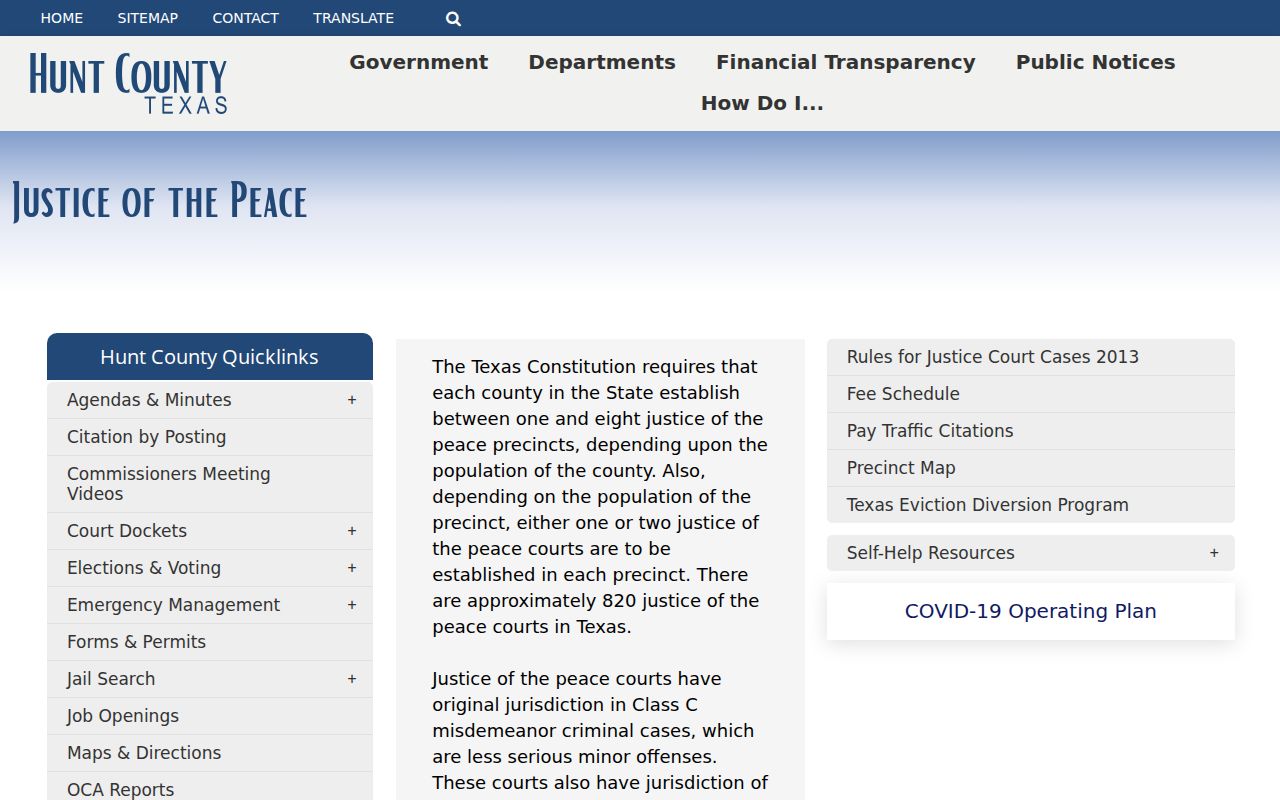
When the ticket names a city, call that municipal clerk instead of assuming the JP has the file.
The county lists four constables who may serve process. The official directory does not assign warrant types to each precinct.
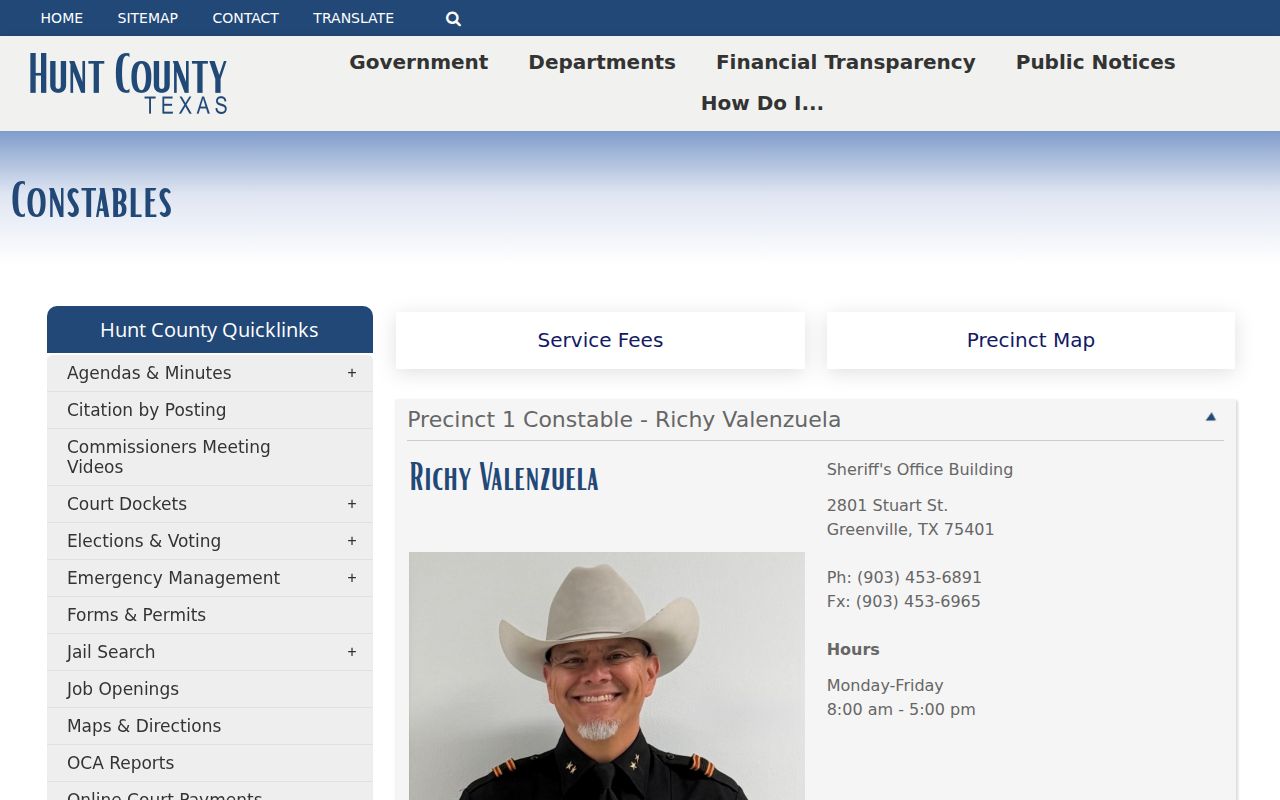
Ask the issuing court which agency has the service task.
Hunt County Court Assignment Map
Hunt County’s court hierarchy separates a city or JP ticket from a misdemeanor filed with the County Clerk and a felony filed with the District Clerk. County Courts at Law handle Class A and B misdemeanors, while the 196th and 354th District Courts hear felony causes. A missed date follows the underlying file to the court that set it.
Do not use a court’s general docket date as proof that a warrant has been recalled. Ask the assigned coordinator or clerk for the current order, then keep the written response with the case papers.